
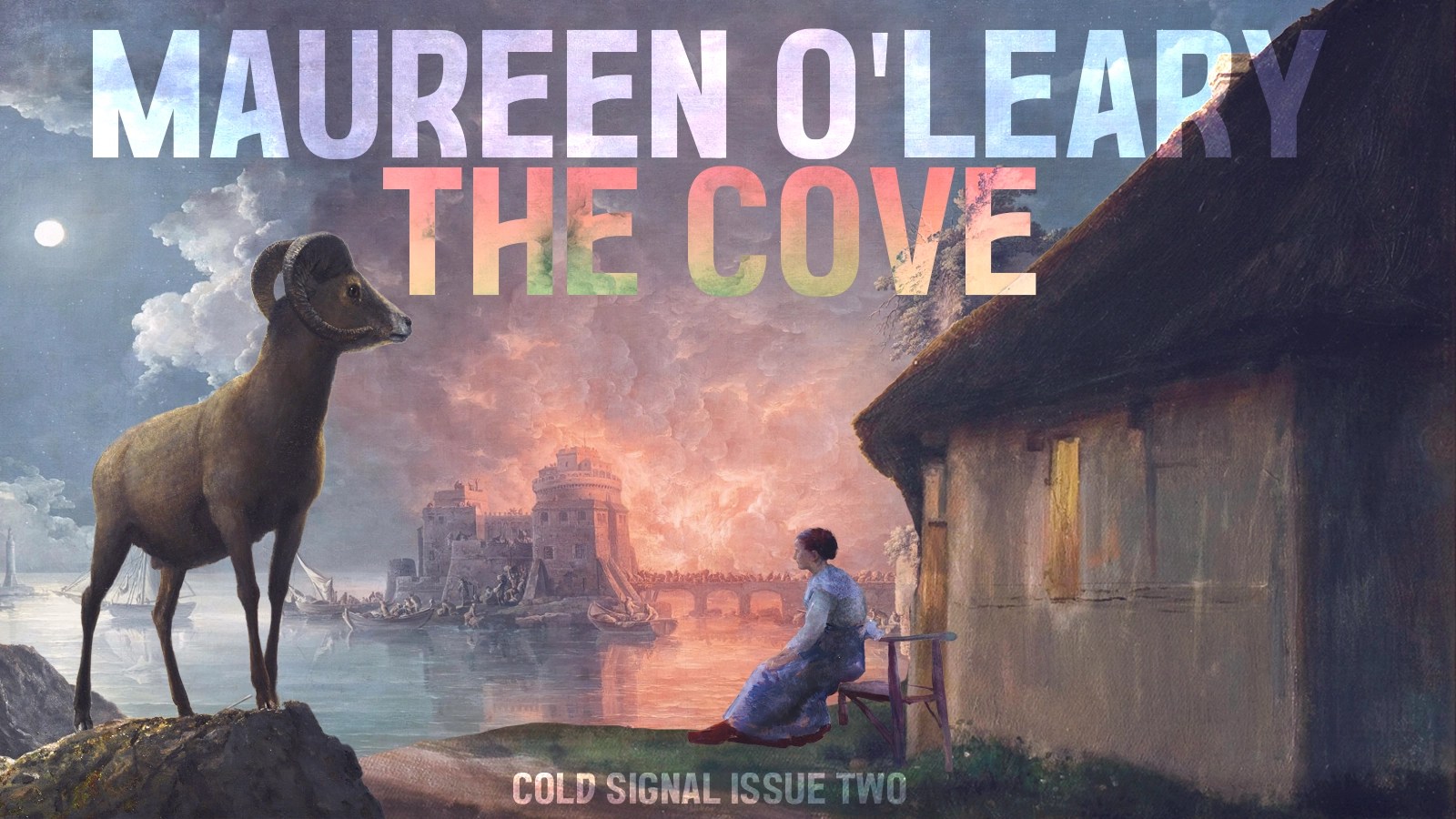
The Cove
by Maureen O‘Leary
Syn
Ancient people were suckers for a mass delusion. Despite their somewhat sophisticated architecture, medicine, and even rudimentary space travel accomplishments, they went to church. They believed in money. Cove Lila’s diary reflected some of these ludicrous thought patterns. Dr. Syn Kola had read the diary several times as lead researcher for The Cove Project.
Nonetheless, the ancients were peace-seekers. They wanted order, world that made sense. Syn sympathized, at least, with their quest for perfection.
Syn grew up in a city built like a vertical honeycomb, small apartments stacked on top of one another in complexes that reached one hundred stories. The city demolished buildings as they emptied because of population shrinkage. Life was so much easier now than in 2023, so much more minimalistic.
Her computer screen shifted with a blink. She returned to Cove Lila’s diary, which archaeologists found buried under a ruin near the shoreline. The paper was made from wood pulp, the ink of copper phthalocyanine and iron oxides.
“I am so lonely.” A four-word sentence on a page. Syn searched the Old English word lonely. A noun. An emotion. Unpleasant solitude.
The outdoors beckoned. The fog rolled in from the sea, chopping the sky into inexact shapes. Language wasn’t enough to describe this vision. She wondered how anyone ever got work done in the days when people went outside. How did they not fall in love with Sky? With Dirt? With Sea and Sand and the gods that lived in all of them?
The Cove Project
__The Cove was an unincorporated neighborhood along the Northern California coastline, largely destroyed in a cataclysmic event known as The Great Sink. The Cove Project is funded by UC Berkeley Archaeology and Mystical Studies Department and led by Dr. Syntia Kola, leading scholar of Ancient Religions. A recent discovery of seven long-buried turf-roofed houses in the Cove “shed style” offers new insights into this mid twenty-first century North American enclave. The document known as “The Diary of Cove Lila” was found preserved in plastic under the third dwelling.__
Lila
Ted’s boss offered him a promotion and the use of a cottage in The Cove to weather the pandemic. Lila could hardly believe the good news. Her husband looked younger as he poured champagne to celebrate. Things were finally happening for him at Horizon Tech.
Since the lockdown, Ted’s advancement in the online banking company had stalled, leading him to seriously consider starting his own company. Maybe they could come up with a unicorn idea. Others had done so, why not them? he brainstormed out loud. They could design an app to help people lose weight, find local live music, sell their used belongings. But every idea he struck at was already invented, already created by someone younger. Lila had the sensation of time slipping out from under them, like a moving sidewalk they couldn’t gain footing on and so were doomed to ride flat upon their faces.
Ted and Lila had met and gotten married in their early forties, too late to consider having children even if they wanted them. Lila was an administrative assistant at a private high school in midtown, furloughed since the pandemic. She loved exercising, online shopping with two-day delivery, and the free time to write in her journal and craft short stories. Her stories were always rejected when she sent them to magazines, but she liked the tiny hope that one day she would be chosen.
When Ted’s boss offered the cottage along with a better position, Lila was relieved. Ted and Lila weren’t the type of people who invented companies. They weren’t unicorns. Lila privately thought there was no shame in being sheep. Ted would have been hurt by the idea of not being special, but if no one was willing to work support jobs, nothing would get done. Civilization would not exist. There would be no institutions, no cars, no schools, no factories. There would be hospitals full of surgeons, but no nurses. Schools full of administrators, but no teachers. It wasn’t necessary to be special in order to be essential.
They packed their things and left their apartment in the city behind.
The Cove Project
__At the time of The Cove’s inception, a cabal was established to enforce the plain aesthetic of the domiciles. For example, only gray and olive green stains were allowed. Punishment for deviance from the aesthetic was banishment.__
Syn
Syn stood on the cliff to savor the salty wind on her face. One thousand years in the past, Lila looked over this same ocean. Her people lived in homes as uniform and plain as their vows of chastity, though they jostled viciously for prime positions on the land. The houses nearest the water were prohibitive save for the wealthiest among them. The smell of the ocean was intimate and carnal. Syn breathed in deep. She couldn’t get enough.
From an evolutionary standpoint, the human mind was as limited in Syn’s lifetime as it was when The Cove was a bustling herd of wealthy white landowners, but civilization was less bent on implosion now. Humans in The Cove’s time shit where they ate and they ate everything. They gnawed away at the planet until the planet struck back with catastrophic events such as volcanoes, sinkholes, earthquakes and pandemics. Syn’s hypothesis was that the planet got her revenge with sentient consciousness. The ground knew what she was doing when she swallowed The Cove and Lila whole.
Syn retraced her steps to her home pod. Her feet hurt, unused to walking on raw ground. She’d lost track of how far she’d gone. As the sky purpled, she kept her gaze down to keep from stumbling, which was how she noticed worms wriggling in puddles. Syn bent down to peer at the translucent creatures with segmented carapaces and multiple legs waving in the water like cilia.
You little beauties, she whispered. You tiny wonders.
Lila
The cottage was perfect, with hardwood floors as glossy as heated caramel. The living room furniture was upholstered in ecru linen. A spotless duvet of the same colorless color covered the bed. These fabrics came from the earth this hue, from the cotton boll, from a sheep’s back. Ted and Lila ate supper together on the back deck. They talked. Laughed. Lila thought she’d never been so happy.
That first night, she awoke from a dream that she was covered in wool. She went to the bathroom to find a cacophony of blood pouring from between her legs. A glob of uterine tissue dropped from the angry fist of her womb and splashed into the toilet. She stared at her blood-soaked pajama bottoms with creeping dread.
She returned to the bedroom and held her breath before switching on the light, holding on to the moment right before everything would be ruined and all her fault.
The Cove Project
__Most citizens of the former United States worshiped an amalgam of ancient religions, law of attraction philosophies, astrological theories,, and living idols. The dominant Christian mythology supported archaic policies that subjugated women. Despite their claims of progressive atheism, the residents of The Cove were steeped in mysticism. The Cove’s leadership was exclusively male, steeped in the same misogynist paradigms of the rest of the country. __
Syn
Syn walked along the bluff and pondered the predicament of women in The Cove’s time. A woman’s body had such a propensity for blood and pain. It must have been difficult to face a lifetime as a physical female with so few choices. Back then, humans born female mostly remained at the mercy of their cycles.
Syn had her womb removed when she chose not to be a breeder, but she retained every other standard biological marker of womanhood. Her pleasure in the embodiment of the feminine aesthetic gave her a deeper affinity for the ancient people she studied.
In the plum gloom of pre-sunrise, Syn caught a dash of movement in the overgrown cypress forest to the east. She turned to the path towards the trees curved like a tunnel of tall gray women. She imagined being a pregnant four-legged animal, fetus hooves scraping her uterine walls. What would a full uterus feel like? She imagined a lead weighted stomach. She imagined a swallowed stone.
In her peripheral vision a woman with long gray hair and eyes like milky glass appeared at the base of a cypress tree. From far away there was the sound of a child calling. Not a child. A lamb.
When she looked again, there was no one there. She found she’d stepped in something soft, that her boots were sinking into the gooey neck of a long dead mountain lion covered with amber fur. A flurry of white baby centipedes crawled from the eye sockets. They swarmed her feet as if they were magnetized. Syn kicked them off. She felt afraid and ran away.
Lila
Ted ran the bloody sheets under cold water, scowling into the sink. “You’re fifty years old. You couldn’t predict your period?”
“Let me do that,” she said. He ignored her. She stood with her hands like mitts at her sides as he scrubbed at the stain. After an hour of toil there remained a rusty penumbra of blood. The mattress was ruined as well.
There was nothing to be done. In the morning, Ted closed himself in the study to call his boss. Lila lingered outside the door. When Ted came out, he startled at finding her there. He lugged the mattress out of the bedroom, the damp red spot an accusing eye. She didn’t ask what he was doing. He wouldn’t answer anyway. He flung open the sliding glass door so hard, the wall shook. The mattress resembled a giant grub with German tags sewn onto its back. When they’d looked up the cost for replacement, they’d found one selling for ten thousand dollars.
Ted pulled the mattress into the meadow. There were no fences between houses in The Cove. Every yard opened onto grassy fields marked with paths that led to the sea.
He retrieved the sheets from the laundry room and threw them on top of the mattress. She watched, astonished, while he soaked the bedding with charcoal lighter and dropped a match. Flames shot high into the leaden sky. Ted’s face glowed orange in the firelight.
“David said to do this.” David, her husband’s boss. “He was very specific.”
“Weird.” Sparks popped from the ignited ticking.
“He even arranged for the delivery of a new bed and sheets too. He said not to worry about paying.”
When the fire died down he kicked the coals into a circle of ash.
The Cove Project
___It is relevant to note the significance of the sacrificial lamb to Judeo-Christian mythology. The kingpin of Christian belief was alternately referred to as the Lamb of God, the Blood of the Lamb, and the Good Shepherd. Christians were often called his flock. At the time of the Great Sink, North America considered the term “sheep” a political insult, denoting a mindless follower with no mind of one’s own. The symbol of the martyr, or the sacrificial lamb, was an archetype in which the hero sacrificed the self for the greater good. The hyper capitalist economy at that time required the sacrifice of many in service of the few. These sacrifices were considered honorable necessities of the so-called American Dream.
The logic behind the iconography of The Cove makes sense, then: Two curls on either side of a vertical beam. The copy for tourists and residents named the image “The Spray”, evoking the plume caused by a whale’s exhalation offshore. It does not require close study to recognize that the graphic resembles the head of a ram. And on closer study still, an artistic rendition of a human uterus, fallopian tubes, and ovaries.__
Syn
Assistants organized the materials Syn gathered to create a picture of The Cove’s daily life. She reviewed the findings late into the night to prepare for the team arriving to excavate. Her domicile pod was in the ruins of a neighborhood outside the Cove’s property limits. Before the Great Sink, the mountainside homes were five kilometers from the coast. Now, the ruins were mere meters from the edge of the bluffs. The Cove proper was underwater, but ultrasound data assured copious artifacts beneath the remaining ground. They would begin the dig in the morning.
The Great Sink was widely known as one of the seminal catastrophes that led to the New Winter apocalypse, alongside the Loma Prieta earthquake, Covid-19, and the Icelandic-North American volcanic eruption clusters. The Cove was a center of blood rituals designed to attract money and power to the ultra-rich men who owned the land. In the time of the Great Sink, pandemics were already decimating the population. Wildfires burned down entire forests. The ice caps were melting and sea waters were rising. Then came the New Winter, a swift, murderous Ice Age after four cataclysmic volcanic eruptions in quick succession. Remaining humans took to cities like minnows escaping the shark of nature. They continued as a species in tiny fishbowls as compared to the enormous houses they once lived in. Oh, the way humans used to take up space!
Human beings arrogant enough to think they could own land would never concede property willingly unless nature forced them.
An aerial photograph of the sinkhole appeared on her screen like an enormous eye staring through time. She peered into the pixelated image and wondered what noise the hole made.
There was a knock at the door. The team wasn’t due for ten hours. When she stood she felt a dropping in her lower belly, as if she were holding something heavy in the hammock of her insides. She had no womb. She had her hysterectomy at fourteen like most girls did. Still, she felt the weight and she rested her hand where her womb would have been. She put on a smile and went to greet Anxel and Bren from the University. But it was not Anxel and Bren. It was a ram, butting the door. She saw the “spray” there in his alien face and curled horns.
The animal stepped away on dainty hooves, as if wanting her to follow. She grabbed a headlamp. The soft soles of her bare feet shocked at the cold ground. A tiny rock cut into the untested skin there as she ventured into the darkness.
Lila
Ted’s boss wanted to take them on a walk. Ted put on a new pair of hiking pants that swished when he walked.
“What are you thinking of wearing?” he asked. She sat in a chair in the bedroom, her hands cradling a perfectly hot cup of coffee. Her journal lay on her lap. She wanted to be alone in the cottage to write.
“Are you sure I am invited?” she asked.
“He asked for you,” he said, shaking his head at the mystery. “Maybe wear your hair up.”
She put a hand to her black hair shot with strands of white. She did as he asked and later on the trail found David nicer company than she expected. She’d expected to feel embarrassed over the soiled sheets, but he never mentioned them. He asked about her writing.
“Oh, my stories don’t mean anything,” she said. No one ever asked about her writing.
“How so?” He asked, gripping a large walking stick.
“They are stories about nothing,” she said. Embarrassed after all.
“Then they are stories about everything,” David said. “Nothing is the greatest subject.”
He placed his hand on her shoulder and his touch moved her. Warmth spread down her thighs as he turned her to face the view from the top of the hill.
“Beautiful,” she said. From this vantage, the homes appeared to have sprung from the earth organically and the space beyond the ocean was as big as the universe.
“I knew you would be able to appreciate how special this place is,” he said.
“This is a wonderful trail,” she said.
Ted nodded like a pigeon in agreement.
“The trail, yes.” David’s tone was patient, as if he were a professor helping a student who was missing the mark.
“Just fantastic,” Ted said.
The view was a storybook page of a rural landscape. A place where nothing disappointing could ever happen. Sheep bleated on the hillside. A salty breeze cooled her face. There was no traffic here. No pandemic. They weren’t wearing masks in this fresh air. From this height there were no political arguments. No cause for protest. No global warming.
There was a shepherd around the trail’s bend in work boots and heavy gloves. Lila heard the flies before she saw them.
David translated the man’s Spanish. “Albert says he found them this morning,” he said, gesturing to a mound of bloody sheep with their throats ripped open. When Albert spoke again Lila heard a word she recognized: puma.
Ted avoided looking at the twisted necks and the intestines stringing in the dirt. She wished he would face them, so that he would see that life is messy. Everyone bleeds. The top one’s leg was still twitching.
“We lose a number of livestock every year to mountain lions,” David said. Lila caught the smell of raw meat warmed by the sun.
“Are the mountain lions still around?” Ted scanned the landscape, one hand a visor. Sweat rolled from the top of Lila’s neck down her spine. She put her hand to the small of her back to feel the moisture pooling as she noted the ewes’ tongues poking through their teeth. The shepherd was waiting for her to leave before he could continue his work. Iridescent flies lit upon the gleaming purple viscera. David and Ted were already further up the trail, but she would not rush.
She understood that she was supposed to linger at the sheep. She was supposed to see them bleeding into the soil. This moment was for her.
Finally she nodded to the shepherd and followed the men to the top of the next hill. At this new height, David pointed out that the field behind their cottage was the geographical center of The Cove. He handed her binoculars to see for herself.
“What are your thoughts about our community?” David was talking only to Lila. She felt chosen.
“This place is everything,” she said.
David nodded thoughtfully as if she were the wise one. She felt as if David had delivered her to that trail, those sheep, this revelation. Every step was a test and she was more than passing. She was exceeding every expectation.
“Yes,” he said. “You understand perfectly. I knew you would.” He rested a hand between her shoulder blades and her entire body tuned to his touch.
“This place is worth preserving,” Ted said. It wasn’t the wrong thing to say. David clamped him on the shoulder too, and the three of them were connected by one powerful electrical force, David, the source of their happiness.
Syn
Syn followed the ram that had come for her to the tunnel of gray cypress ladies. The hairs on the back of her neck stood at attention, an evolutionary signal to be wary. She observed the sensations of fear in her body. The shortened breath. The sweat beading on her hairline despite the cool night air. She had rarely been afraid before coming to the Covelands site. None of the seismic instruments at the pod suggested danger. Fear did not always connote danger.
She stopped where she’d found the lion’s corpse disintegrating in the grass. There was, in the lion’s place, a dead ewe, her tongue distended over humanish teeth as if she were laughing.
There was a mystery here. Syn moved to her hands and knees,stretching out on the grass. She brushed the grit from her bleeding feet. There was no sound beyond the pounding of the surf. She lifted her shirt and pressed her belly to the ground, the cold making her gasp. Grass tickled her ear as she listened for a heartbeat pulsing through the earth.
The Cove Project (Apocrypha)
__The purpose of the female researcher on the landscape was to replicate conditions that preceded the Big Sink. Though the Covelands are reduced to a sliver of forested coastline and the female researcher had no menstruation, the purpose of the woman was to create a mirror of Cove Lila and the conditions leading to the Great Sink.__
Lila
David invited them for dinner at the lodge where a negative virus test was required for entry, as was the company of a validated homeowner. Ted took an hour to get ready. Lila watched as he studied his profile in the mirror, sucking in his gut.
“What are you wearing?” he asked. He pulled a sweater over his head, the blue shirt underneath already sweaty.
Lila reached at first for a black dress but stopped. She went for white jeans and a white t-shirt, feeling as easy in her body as a fourteen-year-old boy.
“You’re wearing jeans to the lodge?” Ted asked. “You’re wearing white after what happened the other night?”
“I can stay home if you want,” she said. But she knew that David had asked for her specifically. Lila never looked forward to a meal more.
They drove to the Lodge in silence. Lila’s leg muscles hummed after the long day of hiking. Ted was nursing his left knee. In the parking lot he stepped over a puddle and made a hissing sound of alarm. The puddle was swarming with small whitish creatures with many legs.
The Cove Project (Apocrypha)
__The end of the female human reproductive cycle was often marked by heavy menstrual cycles when the assigned female body lined its aging uterus with copious tissue despite the lack of a viable zygote. Think of a mother bird (back when there were birds) feathering a nest (back when there were nests) with extra down in hopes that the luxurious space would attract a family (back when there were families).__
Syn
The day of the team’s scheduled arrival passed. Syn walked along the bluff, baby centipedes clinging to her pants. She forgot to eat. She slept outside. Her hair grew stringy.
She listened to the ocean, the ground, the beautiful sky filled with clouds that resembled the open arms of a beautiful woman. I want you, the voice promised. I want you most of all.
But nothing came for her for days. The ground stayed quiet and she was very alone. She stared at the sun until her eyes turned white.
Lila’s Diary
I am no longer lonely. I’ve been dreaming like a teenager, waking up with instantaneous orgasms, way stronger than any I have ever had, either by myself or with someone else. These aren’t regular sex dreams. There is no man, no woman, not even myself. There is instead a nothing that knows me better than Ted knows me. Better than I know myself.
The Cove Project (Apocrypha)
___Lila’s Diary is Artifact 1 of the archive for the Cove Project. From this document, Dr. Syn Kola surmised that Lila was aware of her role as sacrifice to the unnamed (or to the date of this writing undiscovered name) deity The Cove residents revered and paid homage to. Sheep were symbols of the sacrifice (see appendix 7.a re: The Spray). The Covidians saw the blood of a menopausal woman as a source of power. Retrieved archaic digital notes created by one David Ross suggests that the Covidians believed in a supernatural relationship between menopausal blood and the personal wealth of the landowners, of which there were five individuals (David Ross being one). Further philosophical connections between wealth and menopausal blood have not been discovered at the time of this writing.___
Lila’s Diary
The point of the woman is to bring forth abundance. This phrase came to me when I was walking and I almost wrote a story when I got back. The Point of a Woman would be the title. I want to say here that David Ross has never lied to me. Also, he doesn’t know as much as he thinks he does. He thinks I will sit with my bare ass on the ground in the field behind the cottage and bleed into the dirt and that will be enough to appease the ground. The blood will awaken the ground but the blood will not be enough for the ground.
I know what I am getting into.
Tomorrow I will bleed again. I can feel the cramping I used to think was useless. Why experience pain if I am not giving birth? But I don’t think about the cramps as pain now. I feel each contraction as a sensation that requires all of my attention.
Syn’s Diary
There is a cosmic force in the land here that generates undiscerning chaos. The power attracted tech giants, witches, ghosts, lions, the wealthiest people in the world, muscular insects with too many legs, wild weather, a landscape of such beauty that only a highly privileged few were allowed to come here.
The Covidians summoned a life force present in the universe during the Big Bang, the forming of the Earth and the birth of the Sun. And this life force wants me here.
I know so much I can’t put in the report. Not yet. I have theories about land that has hungers as vast as dying stars that pulls entire solar systems into their orbits for eons before being satisfied. I have theories about the iconography of the ancients around female bodies. The ancients were fascinated with pregnancy, conception, female sex organs, the labia, the clitoris, breasts. They passed laws punishable by prison over myths of conception and the human rights of a zygote. They thought they could control Life.
The point of the woman was to flow life. The point of the woman was to flow life. The point of the woman was to flow. The point of the woman was life.
Syn
On the seventh morning after the ram drew her outside, Syn rose from where she’d been sleeping on the ground. She followed the pounding waves to the edge of the bluff. Her lungs burned in the fresh air. She brought her fingers to her face and felt the squirming backs of baby insects whose tiny jaws fastened to her skin. She tugged them away, leaving bleeding wounds. She pulled them from the base of her throat, from her scalp, her ears. Blood slicked her hands and ran down her neck. A sudden magnetic pull felled her to her knees. Her hands broke her fall and her blood seeped into the soil.
The ground rumbled. Rocks tumbled to the waves far below. The earth loved her. Her final emotion before the ground gave out beneath her, and her head split against the rocks and her sharks tore apart her body, was the ecstasy of being desired.
Maureen O’Leary lives in California. Besides Cold Signal, her work appears in Bourbon Penn, Nightmare, Chthonic Matter, and other places. She is a graduate of Ashland MFA.
 COLD SIGNAL