
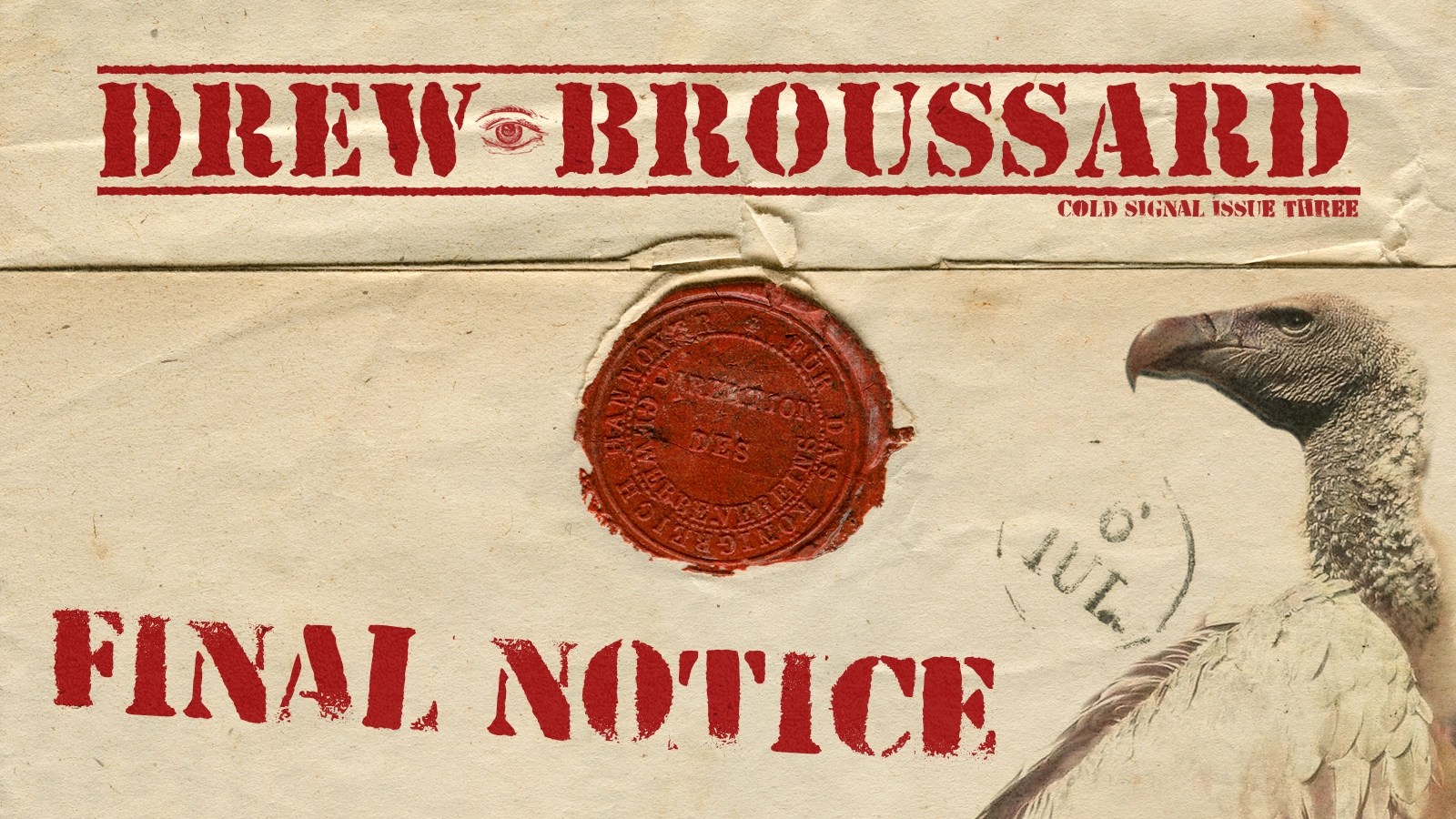
Final Notice
by Drew Broussard
It comes as something in the mail.
You’ve no doubt seen the kind of mail I’m talking about—the kind that makes you wonder who sold your address, and when, and how much they got for it.
Sometimes, if you’re paying attention, you’ll get something that doesn’t make sense: a white envelope stamped FINAL NOTICE. But you’re a canny one; you know you haven’t had any prior notice about anything. Paid up on your credit cards, careful with the mortgage—maybe it even had the wrong name on the envelope. Into the recycling it goes, without a second thought.
But they are patient.
In the end, it begins with an offer, a chance. “Look inside for your chance to win!”
“Great offers inside!“
It often depends what you need, or what they think you need—and don’t we all need something? They can send out a thousand of these, and nine hundred ninety-nine of them go up as kindling or get turned into wood pulp, but that last one…
You’ve thought about it, you know you have.
What if…? Maybe this time…?
And so you open it, even though you know you won’t find anything useful. The coupons, the deals, the offers; they’re too limited, too specific, already expired. Nothing you need, nothing you want, and so into the bin it goes like all the rest.
The only difference: this one, you opened.
The next letter arrives, without fail, within a week.
It is unmarked, with none of the fanciful adornments they used to try to hook you in the first place. A white envelope, your name and address typed straight onto it, the cancellation mark smudged over the ordinary stamp.
No return address, or if there is, it’s something nondescript—a PO Box, a generic street, an unassuming town.
Could be that your bank is sending you a new credit card, you think. That happens sometimes. Or something else sensitive, a bill or a check. Best to look, just to be safe.
And so, you open it.
The frown starts as a contraction of the eyebrows.
Then a pursing of the mouth.
You see your name amidst the dense legal (is it legal? It must be) jargon, but everything else defies your attempts to make sense of it. The confusion is immediate, thick and cloudy, and so you fold up the letter and return it to the envelope to re-examine later.
You put it down on the counter, just…
Just there? You could’ve sworn it had been right there, you say to yourself or your partner or your pet or child, whenever it is you go to look for it again,but the frantic swirl of life distracts you from thinking about it any further, chalking the paper’s disappearance up to a cleaning spree, a now-forgotten realization that it was spam after all, something like that.
When the second note comes, the shock of remembrance is a physical thing, related to the pit of fear that opens in your stomach as you look at the sharper language—still legalese, but you understand its tone better now, that it represents a threat.
Maybe you call a partner over, if you have one. Or a friend, if you don’t.
“I just got this strange…” “Have you ever…?”
Most of the time, whoever you’re talking to doesn’t know. They haven’t ever.
There’s a phone number, there’s always a phone number. With nothing else to grasp at, the phone number extends a hope of contact, explanation, correction, confirmation that it wasn’t you to whom all of this was referring.
Depending on when you try, the line might just ring with no sign of stopping. It might ring once and then not at all. Maybe you’ll even hear the click of someone picking up, but immediately it gives way to static.
Frustration will lead you to try again. Right away or sometime later; it doesn’t much matter. At some point, when you’re just on the verge of giving up, you’ll hear the line engage and a pleasant “Hello?” will slither into your ear and spark that last flame of hope alive again.
You’ll scramble to reply, explaining that, “Yes, hello, I’m calling to inquire about a strange letter—”
“Hold please.”
Something is wrong with the music on the hold line. Like the tape was fluttering when they recorded it, like the LP was warped from the sun. You likely won’t be on for long enough to notice that the song is a loop, nearly impossible to catch where it ends and begins. If you do catch it, and if you hang up right at that second—but almost no one does.
Even after the call drops, you’ll call back. Even if it happens again.
You see, now the hooks are in.
Meanwhile, just as the computer seems to know when you’ve been talking about wanting a new sweater or that you’re out of milk or that you’ve finished that book and want the sequel, it knows that they’ve been in touch.
Like vultures circling ever-lower, the spam proliferates. More Nigerian prince emails, more ominous urgings of actions you ought to take about topics you don’t understand, more coupons for websites you don’t think you’ve ever been to. They slip through whatever nets you’ve strung, into your inbox and past your ad-blockers.
The algorithms that synthesize our lives see it happening and the loop begins to build, feeding back until you almost can’t operate for the density of it all.
The postman spends longer at your mailbox, shoving the rubber-banded stacks of mailers past the catalogues and magazines that must be multiplying in the dark. Your phone keeps ringing with unknown numbers, leaving messages that sound like robots except where the words slur into something that isn’t human. Your inbox fills faster than you can keep up with.
No genius nor geek, no online form, no factory reset is able to staunch the deluge.
One day, you find an envelope in the mail stamped FINAL NOTICE.
This one has your name on it. It has a weight to it that implies, well, finality.
Odds are, you rip it open right away. You could wait, but it won’t matter if you do.
You open it and the language that had been battering at the door of your mind, looking for cracks, finally breaks through and—you understand! You see it, now: what they wanted from you. What you did, by signing up or clicking accept or, yes, even just by opening some innocuous mailer.
What you invited towards you.
And as you are consumed by it, the debt comes paid and that final notice proves a stamp on an already tenuous existence. Your time pops like a bubble, and you are gone from this world, and they are sated.
For now.
Until the next sucker comes along.
Drew Broussard is a writer, producer, and bookseller in the Hudson Valley. He is the podcasts editor at Literary Hub, where he also hosts The Lit Hub Podcast and Tor Presents Voyage Into Genre. His writing has appeared in The Southwest Review, Oh Reader, Unbound Worlds, midsummer magazine, Litt Magazine, Club Chicxulub, and friends’ mailboxes. By day, he is the bookstore manager for Rough Draft Bar & Books in Kingston NY.
 COLD SIGNAL