

1
There was a ruddy star in the sky.
It is how all stories imaginable end.
The ruddy star was not beautiful and it did not shine, but you could see it up there, as one man did, from up on the ragged mountainside on which he lived, the scrubby dust of the desert laid out before, beneath the mountain, a parched tableau of dust and sand and trees hawked into cowed wounded shapes like the mummified; blowing red pocked rock, snake trails deformed by wind and rabbit, sometimes the staid potted forms of freed cattle wandering with sucked in undercarriages, uncertain of their preference for thistle over wire; the sky then looking wet from later afternoon to evening and aftereve, not for rain or cloud but colour, the red rock and the beige and their cusps and bowls and coves and branch-studded cliffs sodden first with sunset, next with shadow, canvas to a runoff for it was the above that was the true thing, the sky become lakelike and flower-hued before beginning to shine.
The man sat out with his box of rust which should, if it were active, run the little two room house. He stuck spanners into it, blew into it. It was neither intentionless nor hopeless. For it to begin to work would be a surprise, but the repeated trying was a comfort. His adjustments, clinically obtained, allowed for slowness, such trivial cycle without dissatisfaction. They allowed rest in the night’s blueing air, setting down the box and letting the spanners fall to the porch, wide watching of starlight and constellatory grace without worry, without fervour, without the need to know or even wondering; this, very truly, was rest.
His dreams were similarly restful, and he would not properly feel the seam between them and the full sky.
You might not see the ruddy star until it begins to grow.
It is hidden amongst the other shining stars, until, unbeautiful, not shining, it begins to obscure other beauty.
Over several nights, the man saw it grow this way.
At first, a browned blotch, clarity that of a marble in pondwater.
The man was not indifferent to things religious, mystical nor scientifically speculative, but neither was he inclined to grand explanation. This, in pair with his adjustments, rendered him safe from obsession, fright, concern, most onerous processes, as the marble in the long nights rose patiently from the deep, became more focal in the viewable galaxy, gaining, even, a glint of presence in the day sky, when it was uncloudy and not stormy at least, though this was a great deal of the day out across the plains and deserts and the cragside of the man’s home.
These changes delineated the nights: the growth of the ruddy star, the revelations in the sun and somehow in the night of its form, which was not the swirls and fires of bodies gaseous, nor pink cometary trail, but which was unchanging, and still and spiked.
It was coloured like his rusty box.
There was another box, this one rustless, currently running the house. The boys put it in for him.
He hoped the boys would be by tomorrow. They came every four days or so.
They always visited with him.
The boys did not pass tomorrow. He did not hear their truck.
They did not pass the following tomorrow, nor its own tomorrow.
He hoped they would be by. It was always nice. Adjustment did not prohibit him the uplift of social interaction.
On the third tomorrow, he watched an eagle tie a lazy loop against the blue. He sipped his jupitella, jumped very slightly against his calmness when he saw that eagle drop, suddenly, as though in an instant dispossessed of motivation for flight, and it rocketed down and disappeared in the scrub.
He had the thought to go out and look, but it was a long way, and the return would be uphill, and he was anyway soon calmed out of minute fretting.
That night he did not sleep out with his box and tools. Looking at the jagged star painted in and out of cloud, he was come upon with aching head, fluish ache of the muscle, and went inside to bed, there to only barely find sleep.
His bodily hurt did not abate by morning. He took some medicines, of which his freezer held an embarrassment. They pulled away the pain a little but the prickled night’s sleep left him with an overstay of drowse.
He went out and unburied the communicator and spent a small piece of the day trying to bring something up with it. He was uncertain of his setting it up, so was unsure, when he could raise nobody at town, if this was his own failure.
In the beginning of the evening he took out his binoculars as well as his box and looked, for another small piece of the day, at the new ruddy star.
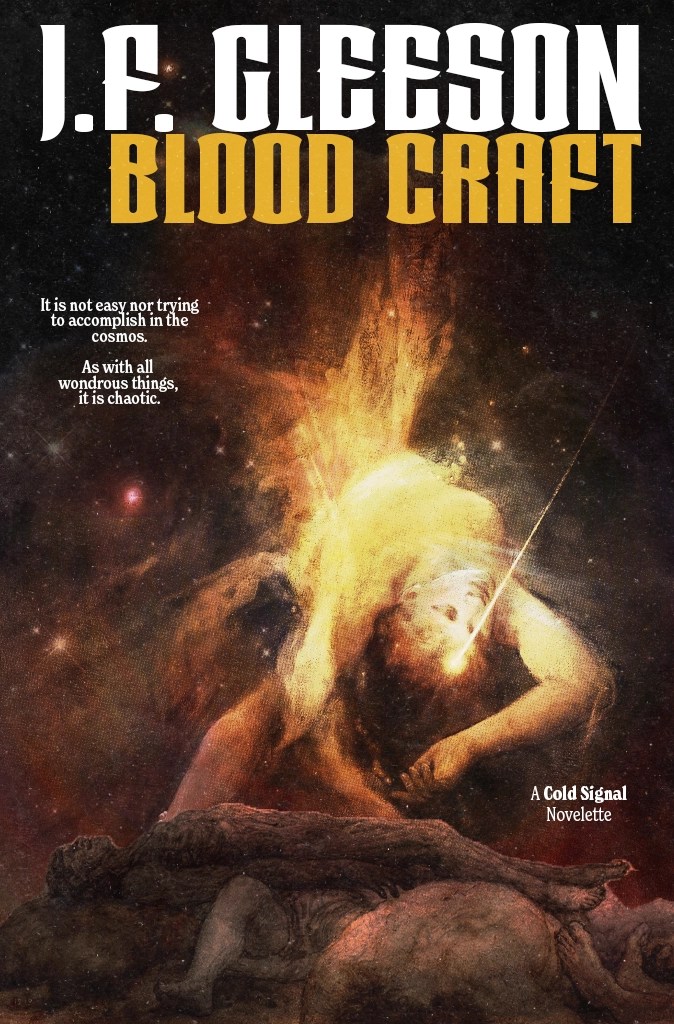
It was a thing not easy to make sense or reason out of. It was the colours of dirt, rust, spilled wine, dark liquor, rotted tree stumps. It looked an agony of craft. It was a violent thing, too detailed, such detail that it could only be perceived as aggression; it had steeples and pinnacles and troughs. It pointed out in many ways.
There was little it put the man in mind of save some picture he had seen in his educational service, stuck in the brain post-adjustment, of very, very ancient churches on the Homeworld.
He experienced a resurgence of the pain.
He felt his body a weighted suit that he would very gladly drop.
He found it more than constant ache, that he had the very irritating sensation of being pulled towards the stars, in fact in the precise direction of the floating church-moon-thing. It rendered him out of comfort wherever he stood or however he sat.
He went back into the house to get away from it, but still it was there.
He lay in his bed without sleeping, feeling without it actually happening that he was rising in minuscule increments up into the air.
His washy way of daydreaming, dreamsitting, wonderstanding, meant that he did not notice all things. He noticed change to the wind of the night, but not the specificity of it: that he had heard no insect for days, seen no snake, had no moth bother around his porch light.
This world had always had a pleasing reddishness to its nighttime sky. It was connected in ways he did not quite understand to its placement in the galactic dust.
He did notice that the sky had never been as red as this night.
He was sure that it had never looked such a mist. He was sure that there had never been a thing like this coagulant fog, thick whichever mark on the horizon he judged from, thickest most as he looked out from his porch left, away, over the ridges, northeast, where the flashy city lay.
You would not be able to do too much about this ruddy star, as the man on the cragside was not.
He continued to sit out with his box. He slept longer and found it more difficult to walk. He missed the boys.
He was calm.
The brown star went away at some time, but not a time before the man dropped his spanners into the dirt for the last time.
The automatons, on the plains and in the ranches, went on at their self-sufficient work for nobody, till they trailed rust in clouds or were smothered lonely in lumps of blizzard.
2
There existed great figures on a world.
There exist and have existed great figures in the cosmos, vast formations of thinking structure that might cow and terrify peoples or in their enormity be unnoticed or mistaken for fissioning thoughtless enterprise.
This world particularly spoken of did not host the greatest beasts to think in the cosmos, though its beasts lived more mightily than most. Their heads, godly, titan, stood up in the brawned power of the cloudwinds that unceasingly tore through and obscured the skies. The beasts did not have eyes, for they predated in no active way, and were giants to the extreme that no other of the world’s lifely things could prey upon them. Their passive skulls like buoyed rocks in terrible rapid did not move with any speed, for the speed of the winds was enough; the cloudwinds raced in limitless bushels through the caves in their skulls, all the good things in them caught in the billion bristles, from where the body’s systems could put them to continued life.
The thinking of these beasts, these mountainous figures, may only have been docile in their cloudful way, may not have ranked much on the sentience of many peoples.
Residual winds howled out from the caves in the lower parts of their necks, and made a very haunting song.
To see this world from a distant place, one would have seen these great rocks disappear, all at a similar time, from the channels of cloud.
Without eyes, the beasts were not to see a strange star or any other. With only docile thought, they had no suspicion of damnation.
The parasite ladders threshed across their backs went first, fell dispersed into the gales.
The mighty things, from cloud to ground, bent their knees in the letting light of the ruddy star; they went away.
3
She stood at a pay telephone outside the city.
She was not well.
She would not have called herself well since the conversation with Cassile, or perhaps since just before, when they had not yet had a conversation but she had known some such thing impended.
She was not vicious to herself but was steadily hateful.
She had bled herself of presence and energy by staying up and awake too far into the night, not because she thought too much of Cassile or too lingeringly dwelled on the sadness she had hoarded since parting, but because, with that sadness, she had relieved herself of care and judgement, seeing further hours of directionless thought as no great thing. She stayed awake to exhaustedly look down tracts of trivia, informations filling enough to push back sleep, trivial enough to not remember. There was a sinking trepidation to the idea of moving from the chaise near the window to the bed.
She was misted through with the resultant tiredness. The fuzz in her brain, if cleared through wakefulness, would compel contemplation of the parting.
The parting had left another list in place of hole; this of inadequacies, armed with which she could steadily hate herself.
No vehicles ran the road. No lights passed. She was stood at the telephone. Door to her parked mobile open. Little spill of light from inside. On the other side of the road the mountainside. Beyond the telephone grass. Beyond that unmarked park, trees. City glow after, icy light, spines and spiracles, polished tonight in absence of cloud, silent, steady.
She went to the mobile and sat in the seat of it with her legs out, pointed towards the pay telephone at which she had stood without making a call; further calls at least to the unrealised that she had cancelled far before speaking, hopefully, even, before it had registered at Cassile’s telephone.
She had not spoken to Cassile since speaking to her. They had not conversed since conversing.
The inspecific sound of far vehicles, far highways, drummed up into that background turbine, a wind of hidden source, and was broken no more here than other places. It fit comfortably into place with the miles-away city, the sky a streaked dirt shadow.
It was hot, cool-breezed, not raining though it should.
Her life was not a pieceless puzzle with a slot for Cassile. It was neither that it was completed or full. The puzzle did not exist. She hung starrily like a loose piece of it. Where could she put anyone else?
She had drawn for herself long ago a self-image. She did not possess the proper gravity for love. She did not know what had drawn Cassile. In celestial incorrection, Cassile had been lured in by what must have constituted a false gravity; approached star and found meandering rock.
Pieceless, coreless.
Pointless perhaps.
She could sit out here, in the mobile, in the rain.
She began the drive blurrily back to the city, strut of waking embrittled by fatigue. She was crumbled physically, aching from the dangerous lateness of the nights spent playing games on the screen but only those most repetitive, lounging dejected and dark eyed and putting on the visual to cover the wall with the View seen from up on the towers and blocks. The windows from her flat, basemented in the channel-streets, did not give such height and distance, only gave the channel-street opposite and unbuckled trollies instead of the View.
She came up onto the slope of the riseway. The city lay lower before as though in a miniature crater, icelight up from it. Wonder, a dream, a magicked kingdom, but only if a world possessed such lore to draw present from.
There were a lot of spots and beams on the rise, where normally there were streams and dashing shoots of stars.
She was weary of body and eyelid and brain. As she drew up, it seemed such lethargy had taken toll on the whole of the rise. There were nets and stacks of vehicle lights. Buzzing trucks were still powered but not rolling. Halted mobiles became a great traffic.
She pulled hers up slower to the back of that in front and pulled away at the brake. None of the lanes progressed with any strength. The vehicles moved with the same feeling that strung her. Occasionally one beamed sleepily into the rear of its frontward neighbour. She was unsure, through exhaustion, that she had not done the same.
The rise could often be trafficked, but never quite like this: very quiet, no shouts, scarcely an unmumbled voice, no rocky thudding of machines on the way but the knocks of vehicular abandonment, hum of gradual decease.
This was the only way she felt to drive the rise into the city, though none would continue there.
She opened the door and got out into the traffic.
Others had done.
Others leaned against their mobiles.
Others sat against their vessels.
Others lay upon the ground.
She noticed only without register the shortening of her breath, for it came with a naturalness. There was no accompanying panic; as though the weakened lung had been intended to function this way.
Dreamily someone wandered out of their vehicle and slipped into odd standing beside it. She saw how very white and sick he looked. He moved with the same suggestion. She wondered if he should be driving himself to the wards this way.
It would be fine to sleep for others seemed to.
She watched the man’s whitish stature fall in with the city’s evenglow. He emanated carlight and icelight; he seemed also to stand in indefinite red, perceptible more in the afterglance or the off-look, with eyes directed to his sides or above him rather than directly upon. She was not wakeful enough to be disturbed. This crimson colour was present as though only in the onlooker’s mind, pulsed more like allusion to hue than like real presence.
There were pay telephones at the pull-in and people pulled up into drowsing and unmoving positions by them. They were curled and crawled, some looking lost or walking with shabby step. They did not tend to fall as she looked. They tended to go to their knees, pass willingly down onto their sides.
The glowing man went, as they did, down, like sleep had immediately been pushed upon the body or all power had been shorn from it. He acted entirely as she felt she must feel.
Down on the bonnet of her mobile, she thought. Someone else’s perhaps, if she had roamed at all. She went back, lay back, gazing at the city. Very tired. She saw that her arms were pale. She had ruined herself with those wasteful nights. Ruined the life right out of her. She thought she saw a red haze in a swim along her arms and off from her hands. She thought she saw a red haze over everything.
People lay on the roofs of their mobiles.
Some broadcast came out of the area of the pay telephones.
From here, the View, without it on a screen; and with everything stopped on the rise, neither did she have to drive at speed.
In a moment and its deadness, the blocks of the city up like an artwork in icicle looked very dead as well; very steady, very perfect.
She did not and never would know if a pay telephone back up by the empty parklands on an emptied bit of road were lit up with a returning call.
4
A moment came inescapably, certainly, on every world; a moment, measured in whatever small or large degree of time, during which there lived, of all the world’s living, a single last thing.
There were a great many worlds for a great many last things.
A night world, turned ever away from any lighting star, turned loose from all, was very hot, heated from the turbulence in its innards. This metallic storm blew out from its intestines, blew often out of gullies and over the surface, bringing wavelet winds like brushes through the trees. To standard eye, the black forests on this forever night could not be properly separated from their sky. Since before the little beasts had climbed up from beneath the ground, they had simmered only azure, coloured low as might the embers of comets finally bared raw by time.
So this world did not lend itself to perception of the stellar or the cosmos. As such, it lent itself neither to wide perception of time.
There was little on this world to force upon its beasts and woodlands deference but shadow.
The craft came quietly, rarely, invisibly, as any other thing that had passed in the time of the world’s life, from spiralled dust to roaming.
The wind on the night world came down, through coincidence of time.
The craft could not demand deference of little beasts ignorant of veneration, though as it had done and will always do, it subjugated the blooded and thinking.
Instinct sent the little beasts, after such long living, back under the ground, where it seemed the earth between them and the air might allay the feeling of being dragged at from above.
We know that this was not to be.
After, the world was too hot, and was far too dead.
A thing called a sad lament in the trees.
It was the last thing.
There was nothing left to hear its song and call it sadness.
The wind came up again and blew through the forests.
The emptied night world went on.
5
Within the fountained interiors and dusty groves and fossilised jungles of silenced planets scratched and worried an archaeologist race. In brittle costume of rib and white plate they dug and took on knowledge of the deceased worlds and species.
They had no spoken-of home. Their culture was that of the dead around them. They lived in the hollows, edifices, carvings, complexities of whatever extinguished peoples had flourished on the worlds they visited. They learned, and adapted, and lived and moved on.
In an eon of the existence of these archaeologists they came to a beiged world of settled dust and dirt. Hunks of corrupted moon and stellar waste banged down into it in the rounds of its orbits, bringing that dust and dirt back up into the air and letting it resettle in fine drifting rains, or worse in thick typhoon. These infrequent rearrangements gave difficulty to the archaeologists in the demarcation of the era, thought it was not challenge for which they were unprepared. The greater problem was the differentiation of the structures in the dust; even accumulation of much record did not make it instantly possible to determine between the warped spines of asteroids and the grafted pylons constructed by the planet’s gone peoples. In many cases these two were of the same composition.
The archaeologists settled down into the warrens. They were parasites only to antiquity, used to nothing more than they were used to living in graves. The warrens on this world required vacuum cleansing. Of greatest remark were the ceilings, which were hatched with rungs and art in possibly mathematical media, suggestive overall that what had peopled this world bore combative disposition towards gravity, spending most of their civilisation’s span looking at the ceilings and likely climbing around upon it.
By others, the archaeologists themselves could be named artefacts. It is not easy nor trying to accomplish in the cosmos. As with all the wondrous things, it is chaotic. In their early living, the deathless amongst the archaeologists lived; which is to say, that the collapse of the structural organism did not find its way to their history, and a careful archaeologist, as the great part of them were, might claim to live forever.
Perhaps from this came their societal propensity towards other death.
On the beige planet, both in the sands of the surface and buried down in the tunnels, the archaeologists found the remains of variable races and wilds and of their worldly hosts. All these remnants were present in the same unvaried state: arrangements of blanched white bone. The archaeologists restructured entire species in model. They modelled also the species’ path to extinction, and from their findings and aged data could conclude no perfect story. It seemed the most recent of all things there had passed away at a single time.
The archaeologists boarded their ship, lifted their lives and all obtainable knowledge of the beiged planet’s lives and all other worlds they had occupied on their endless odyssey into their ship, all off together on it for they lived and journeyed as one.
It is not necessary to speculate what brought ending to the people on the beiged world. It is not necessary to speculate what ending had been brought to the creatures on its neighbour longer out in the system, at which the archaeologists had also taken shorter stop. That world had been bored through with ocean beneath its crust of chasms and ice. That world’s surface had been spotted with holes through which the water came up to the air. Those holes in the surface had been entirely clogged with the puckered remains of a plug of ocean creatures, still dryly fleshed. Those ocean creatures had not moved at all during the archaeologists’ stay, save for rises of pressure from the deep swinging them into brief dull motions. There had been no wind. The ocean creatures had been dead.
Neither is it necessary to speculate what ending might ever be brought to the sage archaeologists.
It is true they journeyed endless, deathless.
Till that death, the great end, comes to them; and it surely will, for no exception is made by that brown reeking star, maddening in its distance and passivity.
What happened to them will happen to them, and to them, and to them. Even the nomad immortals will be brought as low as the least of their subjects.
So will be sucked of life, these wonderers.
6
There is no time for warning.
A people did try, and their effort may rightly be called noble.
These people had taken arms up against the rusted star, as many did, and failed to avert the course of universal history, as all others did.
In their waning era which was their slope towards total loss, these people sent warning to a companion system. They knew not whether a people or living beings or sentience took occupance in any of that system’s worlds, but such fatality as was brought by the evil craft warranted endeavour.
The warning signal, sadly, was misjudged. It is the grand kind of cosmic mistake that happens easily in a grand cosmos. These people ran an overestimation of their companions’ receiving capabilities. The signal, built of light, was received on a homed world but not in the intended way; sent so strongly to these unknown companions, the signal incinerated them.
A few sick things kept on. Though all blooded things were finished by the time the terrible star might have passed by.
So the star did not pass, and perhaps that is not so sad.
7
The pod was headed to the Exchange and would take a while getting there.
They had mastered longevity of body and thought, but had not overcome lengthiness of travel.
He hoped for some sensation of Awe at the Exchange. He had seen the Exchange, heard it, felt it, though not in the Real Dimensions. These classifications were open to debate, but such argument was a channel he had not bothered to open, being that he was mostly in conversation with him. Some described these self-disputes as Fulfilling, Fruitful, The Only Solution to Wondering, though he did not see these.
The Quiet Conflict rendered evidence for self-dispute as a benefit or atrophy. One could posit it in either case. The Sole on Nympha found herself unable to agree with herself, their similarities forming a violent buttress between them. The Sole on Polygoni was unable to disentangle herself from her own logics, heading into a tyrannical concord in which she was only further empowered by duplication of inset territorial lust. The conflict ended then as unquietly as one could, only quicker, for once the arrays of Polygoni had devastated Nympha’s ice rings, they spread out into a small system that was now, under a newly dual-minded Sole, unruly with unmade law.
What, it had been suggested, might begin and end in conversation with the self, instead became no variation on war in the traditional way.
The Dual of Polygoni reconstituted herself into a Sole. The Dual of Nympha wreaked intrapersonal warfare until both were imprisoned.
He, knowing this bit of rush history, saw the exercise as a complication of cognition, but had duplicated himself in silk to share the bout of long travel, his people not having conquered such protraction, and the voyage being spent mostly in his craft, which was little more than a tube with some moveable dividers.
The Exchange, when they got to it, would be a Confusing sight, requiring a plenitude of communications between monitor craft to sift the reworkings of gravity and light in its orbit. The destination appeared to travellers more of a mess than it actually was; around thirty percent of the craft, seemingly hanging frozen around the Exchange, had in fact passed through the horizon and were no longer really there. Some had Crossed such a long time ago that they were unlogged and the things inside them, which one might see if the craft had portholes, not identifiable from the locality. Further, earlier craft had gone into the hole by mistake, having misjudged or been wholly unable to comprehend the state of light in the radius.
For now, from his current position, the Exchange could be seen visually only as another star, of millions, indistinguishable to any without the Accreditation or proper charting to overlay.
For now, there was not the anticipated Awe, only Constance, Steadiness, black black space for they sailed an ocean of it, unmanipulated feelings familiar to the travelling so that sometimes they could become Infuriation, Rage, Bleakness, Obliteration.
He sat in the forward station. He slept in the chamber. This was where they might vary in experience, become properly different to one another.
He, of silk, in the forward station, had not projected awakening his originator companion for a much greater distance. He spent some of his time on logic, other time joining the dreams of he who was sleeping; true divergence there occurred, in the dreaming, in the chaotic roll of the unconscious thought.
The lives of the stars can enact in travel, and they did, and the charts must adjust for this. A few stars before and beneath and all around them had since they had set out disappeared, changed, perhaps been tamed by some people in their need, and some had even breathed that first far fire and become, lighting charts where they had not before been lit.
He was Engaged in a life logic when he checked a rear chart, coming out when he saw that it showed three stars disappeared in the direct locale around one that had recently faded away.
There is enough room in infinity for war, and for coincidence.
So he Assured himself.
He graduated from Assurance to Concern when, some long time after, thirty-four stars around those three had blackened entirely, leaving a pit in the current chart.
He permitted himself to wake himself and began the waking in the chamber, which would take some time. He separated laboriously from his sleep.
He saw through simple visual measure that these missing stars had not blinked away, but were being obscured by something between him and them.
While there is enough room in infinity for coincidence, the chance of some other craft, or vessel, or interstellar anything, coming on right behind them on the same trajectory, indeed following them, was sufficiently close to real zero to induce Worry.
It was then confirmed by the ship. Something was there.
This shape gained apparent mass. It gave off no light. It blocked off stars. He hailed it in all media and spectra available to the ship’s travelling power. It did not respond in any way conceivable to him. They were too far from the Exchange to change course and get back on it, which would in any case have been simply an experiment to see if the shape followed. Its location and path made sense only in the event that it had begun travel from the same place and at the same time as they had, with the same destination.
He flashed a single flare at the pursuing shape and gazed Confusedly at the returned image.
He saw something of no natural occurrence.
He saw barbs and spikes and towers.
The spectrograph showed nothing but nonsensical bursts of copper and bronze.
Gravitation, a risk for the power it exploited, could not decide whether the Frightening manifestation engendered no gravity, or generated it in dreadful abundance.
One can perceive a most poignant meaninglessness in the empty trenches of space; but for this reason, when something does happen out there in the voids, it will easily have meaning put onto it by the encountered. He saw no event in which that craft was not intentionally, with anonymous purpose, following them.
He began to Panic no small amount, having never lived such unexplainable circumstance. He attempted to bring his Fright down artificially, though even a little calmer that temple-thing still hung behind their ship, still hung at the rear of his mind.
Then, something too was wrong in the chamber.
He drew himself physically into it, seeing instantly that the supporting fluid was not at capacity. His head was slopped downwards slightly where it should have been floating.
With some Anxiety, he instigated the untraditional procedure to speed his waking, got him out of the reservoir and waited a while, Nervously, for him to wake.
‘Tell me when you are able to process and speak,’ he said to him.
He waited over him.
Lying on the cot, he looked unclearly upwards until his eyes began to move around.
They waited longer, and then he said that he was able to process.
‘Something is following us,’ he said.
‘What do you mean,’ he said, shivering.
‘I mean: something is following us,’ he said.
He pushed him out into the forward station, where he showed it to him.
They looked at it together, one with Horror, one with drained Consternation.
‘What is it?’ he said, in a large way Hopeful that he was still inside his dreams.
‘Nothing.’
‘What do you mean,’ he said.
‘Nothing. It isn’t of like with anything in the Library.’
‘Which will be far outdated.’
‘I know.’
He wheezed. ‘I don’t know that I am recuperating well.’
‘What do you mean?’
‘I feel unwell. I shouldn’t feel so unwell. I shouldn’t feel still dreamy.’
‘Your supports had leaked.’
‘Leaked?’
‘I could find no leak. But they were not full.’
‘How would that be?’
‘I don’t know.’
He ran through algorithms at his direction, as he was not conscious enough to do so.
‘It is getting closer,’ he said.
‘Or are we?’
‘Getting closer?’
‘Yes.’
‘The gravitation.’
‘Yes. But more that it feels like it.’
It was something he had hoped was only a thought, yet he felt it too. ‘It does. Yes, it does.’
‘I shouldn’t be so dreamy.’ He swore and lumped himself out of the cot and into the through corridor.
‘Be Careful!’
He stamped after him into the chamber.
‘Did I bleed into the reservoir?’ he asked.
‘Of course not. What do you mean?’
‘I mean that,’ he said, and the exertion brought him sitting on the floor on the evacuation drain. ‘I mean, look at my bloods.’
They looked at the monitor.
‘Your bloods are all level. They are fine.’
‘Then. No. No, look.’
‘But. No. How is that to have happened?’
‘How did the support get out?’
‘I don’t know. Stay awake. Come on. Are you all right? Stay awake!’ He shook him mildly.
‘You look drained,’ he said.
His eyes then seemed to go back to a dreaming place, as too did he. He spoke only a couple more things that made sense not to the conscious.
He did not know what to call him, when all he needed was to take his name and use it, to summon him back into living.
‘Friend,’ he said. ‘Friend.’
There was no return to thought for the originator. The thing following them was like a cloud, swept over a sun; he was a shadow, noiselessly departed.
Its presence behind them made him feel a lot Lonelier than had he been truly alone.
For a short time before he was likewise pulled of his vitality, he felt more Unique than ever; for that short time between deaths, he was him, and there was not another.
8
Expulsion of universes into others. Impossible contractions; violent recreations. Fire, implosion, rent being, void, gone matter, genocidal stars, cold dead plains that cradled no thing.
Some little few over the course of forever did make their way through these absolute things. Dimensions wrapped tinily and inconsiderably inside of those that are standard for space and time were spotted and found and unwrapped and known about and used as channels for exodus, retirement and rebirth.
Whatever emigration was made, for whatever postponement of infinity, the time acquired by such thinkers was unconditionally limited.
Some put into realities artificial, where they would notice nought but measured, elongated degradation of space.
There is not time enough for prayer, whether to a people’s own gods or to the floating church itself in appeasement.
Whatever decimations of cosmos were escaped, that craft would still arrive, in the sky of a world, in its windows, as a shadow on the readings of space.
And a people, whatever they were, whatever vast traumas they had gotten through ingenuity or mistake away from, would tire into extinction.
So were divested of life all wanderers.
9
The Dead are these lights.
Do you remember yours?
Remember each and every Dead.
Up that one yes it is the one.
Those are your Dead.
Those here, mine.
Tilia, that brightest. She fed five worlds?
And the five she fed around her: Hipo, Prunu, Pyru, Prunavum, in red, Maluss.
Maluss is the favoured of your Dead. Why? Because he did not waste. The four did not squander, but with Tilia’s feeding he gave new being to so many. All those, there. And all these, here, which are your Dead.
Hipo is your favoured, I know. You have longed ever for the water.
But see that Dead begets Dead, through time, begets Living.
The Dead will, as Living, pass on. Do not be frightened.
What after, I do not know. It is not for asking lest our Dead do tell us.
That tale, you have heard, though you would not understand it. Be watchful when the Dead are gone. Be watchful when they go in shadow, for there is a Death Shadow. When that Shadow comes to cover our Dead, come too it will for Living.
I would not understand it, still, and I do not wish to see it.
Let us be back now. The Dead watch over us, watch over each other.
10
The people of the Lilide, called the Lilides, resisted astutely on their red rock world. That horrid star, daytime star, hung dirtily in their sky as it had and will on other worlds. The Lilides began as others to be stolen of their blood, and see in the sky a new red reeking fog. Such is the brown star’s unannouncement that there could be no preparation, and swathes of the Lilides lay down and slept a final rest. Generations of pupae were denied eclosion, drawn of their solutions when they needed it most.
A small den of the world’s people however were inventive and intelligent and very fast. These Lilides, called from then on without expectation the Last, turned inward instead of to outward retreat or confrontation. They removed underground to the planet’s bunkers and commenced living down in them.
The resistance was astute for the Last coated the inner walls and ceilings of their bunker with a found metal composite, such a material that their blood, vapourising and wanting to rise, up in response to the blood-draw of the disgusting star, instead condensed on the ceilings, from where it was redirected to tanks, and could be reconstituted into the body.
It is not the way a people are supposed to live, but hundreds did this way.
They did so for some time.
The blood star did not leave.
A scant few generations went on, underground living, tank-hooked living, requiring endless transfusion for their blood was endlessly pulled out of them, endlessly run back into the tanks. They became very pale and very white, quite pleased at the handsome symmetry of their black-ringed eyes. They moved and spoke more slowly about each other.
The composite was ingenious, astute, an act of brave intelligent futility.
As constant as all else remained, so did the rust-coloured star, visitor to the world.
So blood, somehow, did not condense at a perfect rate. Somehow still there was upward drainage. Somehow that nameless secret destroyer in the sky obtained its eternal demand. The gross blood in bunker, thus on the world, declined. There was less of it and more exhaustion to be distributed.
The Last of the Lilides went wanting, died out as all others, until the Last of the Last.
There was no cause for promise, and no thing like it was spoken of.
‘Say: such lengthened end hopes no extension,’ Cendilla said.
‘This ending is tired, tiresome, tiring, tireful, tireless, yes,’ Timarch said.
‘You say: not dwell.’
‘I did. Say that. A long tired time ago.’
The bunker rooms were spacious.
The hundreds who had given them movement and sound, they had laid one by one into their beds, heard one at a time the final beat of their hearts.
A crackle came from the lock.
Murina appeared in its window, carted heavily into the lock, then on into the bunker. The survivor’s breath came quick, short, coughing. Murina racked to a tank and sat hanging off of its tubes.
Murina would be soon for departure.
Timarch came out to assist. They had grown tired out of irritability, on into seamless camaraderie.
‘The review did not send.’ Murina took space for breath. ‘Did not return imagery.’
‘No mind,’ Timarch said. ‘What little still functions, let alone does as we hope?’
Murina did not look up.
‘No mind, really,’ Timarch said kindly. ‘How are you feeling.’
‘As we are all. All. The three of us all. Ending.’
They sat.
‘It returned a thing though,’ Murina said, lifting up the return box. ‘It returned sound.’
‘Take your rest.’
Murina watched Timarch return to the room of their main occupancy then watched the ground, revisited the swift collection on the surface: the returned review box, the sky paled, the vicious irritant thing unstopping till it had bled them to complete disappearance.
Murina, when feeling mobile, detached from the tank and went into their room, and sat between Timarch and, in the farther corner, Cendilla.
‘How are you, Cendilla?’ Murina asked.
‘Say: quake, current along sphere,’ Cendilla said with no focus.
‘I am scared to hear the sound of our destruction,’ Murina said.
‘Let us hear what noise they result from forcing pure silence on Lilide,’ Timarch said, and the two of them pushed the box in the output and sat at the monitor.
‘Anything of the reviewer?’ asked Timarch.
‘No more than we saw here.’
Murina commenced the sound that had been taken, recorded to box, and jettisoned back to the Lilidean surface.
They spoke not.
There was little to be heard at the beginning, but they sat and quietly waited, there in their bunker where each would eventually be put to bed.
Noise emerged somewhat. High, rhythmic. Spatteringly rhythmic. The rhythm changed as though it did not intend to. So it was not speech or mechanism, they found, as it sounded as the spat of liquid onto solid surface. In quite a small space.
Drip. Drip. And more dripping. The review must have continued travel, moving on through whatever orifice of the ghastly structure it had entered.
And more dripping. And dripping into dripping. And the plopping of liquid rain into ocean.
And glogging.
And splashing.
And trickling.
And rushing.
And sometimes tight.
And sometimes echoing.
The image come to each of them was the same: of brooks of blood, lakes and rivers of it, channels of it flowing, importantly but uselessly, through falls and mazes and constructed canals, of unburnished stone, pouring where and pouring why.
And surging.
And falling.
And roaring.
And bleeding.
The sound record there ended at a gurgle, and they did not speak.
Cendilla, even, latched too long into the planetary monitors for usual interpersonal speech or control of it, spoke none.
The bunker was vast and full of dead.
That thing in the sky sounding very wet then.
They sat in the ruddy dark.
‘There is no one else left,’ Timarch said. ‘It is waiting up there for us three only to die.’
Cendilla let forth a twitch of geological mumbles.
‘Can you believe, us three? Of such great consequence to such thing.’
‘I will always remember the pupa house.’
‘If you were presented, by our universe, two options at once,’ said Timarch. ‘Which would you choose of them? First, to return to a state in which that thing had never appeared at Lilide, and which it never would do. Or, second, to be as we now are, but to know its past, its makeup, its history, its goal, its desire, its all?’
‘Say: tired,’ said Cendilla. ‘Tired.’
*
There was a ruddy star in the sky.
This is how all stories that are imaginable come to an end.
There is an exception, which is that the story of the ruddy star does not end this way.
The ruddy star carries on until the unimaginable, and on beyond that a great way. It does so, untiring, till it can hang in no sky, for there are none left to hang upon.
J. F. Gleeson lives in England. His work has appeared, or will soon appear, in ergot., Dark Void, Beneath Ceaseless Skies, Ligeia, Weird Horror, Crow & Cross Keys, Spartan, Lamplit Underground, Sublunary Review, the Dark Lane anthology series, Maudlin House, Overheard, A Thin Slice of Anxiety and other places. His work has also appeared here at Cold Signal. He has a website: https://deadlostbeaches.blog
 COLD SIGNAL